
'Gleaming Lights of the Souls' by the Japanese artist Yayoi Kusama (1929-2026) is one of the most beloved pieces in the museum collection. The installation, dating from 2008, consists of a single space, four by four meters. The walls and ceilings are covered with mirrors; the floor is a reflecting pool; and you stand in the middle of the water on a platform.
Hanging from the ceiling above you are a hundred lamps that resemble glowing ping pong balls. These lamps change color in a way that transports us into a special rhythm and pulse, almost as though we become one with the universe of the installation. Gleaming Lights of the Souls is a truly lyrical work of art in every sense.


"As infinite as this room is for the senses," writes Poul Erik Tøjner in his anthology 'Louisiana abc', "as finite and present it suddenly becomes when your own heartbeat beats in tune with the transformation of the colours, and the room's quiet oscillation between the most beautiful colours and combinations draws its own fine electrocardiogram, yes, it goes straight to the heart."

TWO MAJOR CHAPTERS
Yayoi Kusama's career falls into two major chapters, punctuated by twenty years of oblivion on the art scene. She arrives in New York in the 1960s and works assiduosly for a decade to make a name for herself. She falls in love with Joseph Cornell, then Donald Judd, and experiences a breakthrough with her two leitmotifs: One is paintings with the surface completely covered in what most closely resembles lace - hand-painted, large, often white infinity nets, as they are called.
Her second leitmotif at the time was sculptural and consisted of accumulations. It looks like surrealism, but it’s just very Kusama: phallic forms made of stuffed fabric, a gigantic universe of small penis pillows – silver or otherwise coloured – that seemingly take over any surface or object – furniture, shoes, entire rooms.
SUCCESS IN NEW YORK
Kusama’s early work has a distinct handmade character that harks back to Japanese calligraphy, but in New York she quickly becomes familiar with the larger artistic field – the public space, the art scene, the media, the publicity, the photographs, the cliché. There’s quite a bit of Warhol about her activities in the 1960s, making films and performances that are both institution-critical and sexually orientated, opening a fashion boutique and making a big splash, including in the press.
RETURN TO TOKYO

But then, in the early 1970s, it all seems to be over. Kusama returns to Japan and starts writing - poetry, novels, music - and is indeed recognised for this. She also continues to work along her established path, but she more or less disappears from the international art world. However, upon her participation in the 1993 Venice Biennale the world seems to rediscover her - again.
Struggling with mental illness for most of her life, since the 1970s she chose to live in an apartment at the private clinic in Japan where she received therapy.
Kusama passed away August 2026.

Louisiana Channel is a non-profit website that provides culture to the Internet, extending beyond the museum’s own events. The Louisiana team produces videos about art and culture on an ongoing basis. New videos are posted at the site every week.
Videos on the arts, featuring the artists.
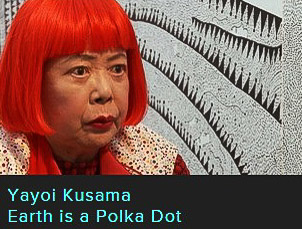
Interview with Yayoi Kusama by Louisiana Channel.


